
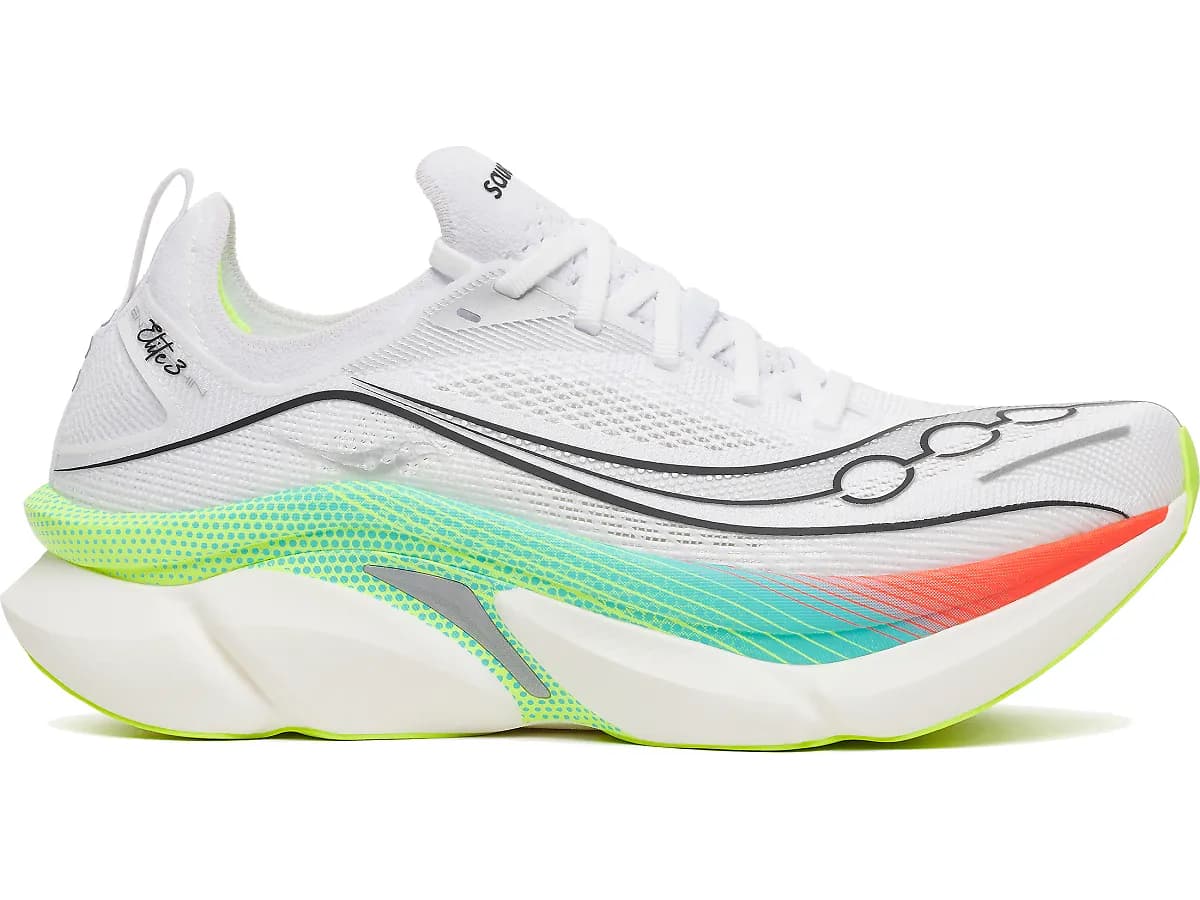


Saucony Endorphin Elite 3 Review
An aggregated overview based on reviewer and runner feedback.
Disclaimer: AI was used to help provide an unbiased perspective on this topic, and all content was carefully fact-checked and edited by human running-shoe analysts. It reflects aggregated opinions from reviewers and runners and does not represent firsthand testing. Learn more →
Overview & Quick Verdict
The Saucony Endorphin Elite 3 is the third generation of Saucony's flagship carbon-plated marathon racer, and it continues the direction set by the Elite 2 rather than reversing it. It pairs the ultra-soft IncrediRUN TPEE midsole with a redesigned slotted carbon plate, a wider platform, and a reworked knit upper, positioning itself as the softest and bounciest option among current premium super shoes.
Across lab outlets, editorial reviewers, and community feedback, the consensus on the midsole is close to unanimous: the foam is exceptionally soft, highly energetic, and unlike most rivals in the category. Reviewers repeatedly frame the ride as fun and forgiving, with energy return figures from lab testing landing among the highest recorded for any racing foam.
Where opinion divides is on the consequences of that softness. The same platform that makes the shoe distinctive also draws recurring criticism for cornering stability, for feeling too squishy at faster or shorter efforts, and for carrying more weight than several lighter rivals at the same price. The result is a shoe with a strong, specific identity rather than a universal race-day recommendation.
Key Stats
- Brand: Saucony
- Model: Endorphin Elite 3
- Category: Neutral carbon-plated super shoe (race day)
- Terrain: Road and track; best on smooth, groomed paved surfaces
- MSRP: $290
- Weight: 7.2 oz / 207 g (men's US 9); lab-measured slightly higher at ~7.4 oz / 210 g
- Stack Height: 39.5 mm heel / 31.5 mm forefoot (stated)
Best For / Not Ideal For
Best For
- Runners who actively prefer a very soft, bouncy ride over a firm, snappy racing platform
- Half-marathon and marathon racers prioritizing cushioning and impact protection
- Midfoot and forefoot strikers seeking maximum protection over long distances
- Fans of the Endorphin Elite 2 who wanted more control without losing the soft-foam concept
- Runners with medium-to-wide feet who prefer a roomier, squared-off toe box
- Runners with heel or Achilles sensitivity, given the collar has no rigid heel counter
Not Ideal For
- Runners who need meaningful stability, guidance, or pronation control
- Runners racing courses with frequent, aggressive corners
- Runners who prioritize the lowest possible weight in a flagship racer
- Runners who dislike a pronounced soft or squishy sensation, especially at slower paces
Pros
- The IncrediRUN midsole is widely described as one of the softest and bounciest race foams currently available, giving the shoe a distinctive, high-energy character.
- Lab testing recorded energy return in the low 80% range at both heel and forefoot, placing the foam among the best measured in the category.
- The redesigned knit upper is repeatedly praised for comfort, breathability, and easy step-in, and is regarded as a clear improvement over the Elite 2.
- The toe box is roomier and squared off rather than tapered, making the fit friendlier for medium-to-wide feet than many racing shoes.
- The wider platform and revised geometry give it more control than the Elite 2, particularly in straight-line running and at slower paces.
- The foam is reported to become more responsive as pace rises, rewarding harder efforts rather than muting them.
Cons
- Cornering stability remains a recurring criticism, with the soft platform prone to feeling wobbly through fast turns.
- Several reviewers find the ride too soft or squishy for confident hard efforts, especially at 5K–10K paces.
- At roughly 207 g in a men's US 9, it is heavier than several lighter premium rivals, which some outlets flag as a value drawback.
- The $290 price sits at the top of the market, and the weight-to-price comparison against lighter competitors is a common concern.
- The exposed midsole and race-oriented construction limit it to smooth road and track surfaces.
Ride & Feel
The defining trait of the Endorphin Elite 3 is a midsole that reviewers consistently describe as extremely soft and lively, with a rebound that stands apart from the firmer trend in current racers. Multiple outlets characterize the foam as compressing deeply underfoot before springing back, producing a bouncy, forgiving sensation across paces.
A frequently noted quality is that the shoe behaves differently depending on effort. At easy paces it reads as soft and cushioned, while at faster paces reviewers report the foam firming up and returning energy more quickly, giving it a dual-personality feel. Saucony attributes this to the non-Newtonian properties of the IncrediRUN compound, though most reviewers credit the combined effect of foam, geometry, and plate.
The redesigned slotted plate and revised rocker are credited with smoother, more propulsive transitions than the previous version. Ground feel is minimal given the near-maximal stack, which suits long-distance protection but contributes to the disconnected sensation some reviewers dislike at slower speeds.
Fit & Comfort
The upper is one of the shoe's most consistently praised elements. Reviewers describe a soft, stretchy knit that wraps the foot closely, breathes well, and is easy to get on, with a fit that accommodates both lower-volume and wider feet better than many racing uppers.
The toe box is noted as unusually accommodating for a super shoe, with a squared-off shape rather than a sharp taper. Heel security is generally reported as good despite the absence of a rigid heel counter, which some reviewers highlight as a benefit for runners with Achilles or heel sensitivity.
Sizing feedback is mixed and appears foot-dependent. Some testers report the shoe fitting true to size, while others recommend going up a half size for length, consistent with sizing patterns across the broader Endorphin line. A small number of reviewers also note that the flexible upper can allow some in-shoe movement, which is worth considering for runners prone to friction.
Support & Stability
The Endorphin Elite 3 is a neutral shoe, and stability is the most persistent caveat across sources. Reviewers agree it is more controlled than the Elite 2 thanks to a wider base, added foam, and the removal of the deep midfoot cutout, but they do not consider it a stable racer in absolute terms.
The clearest recurring issue is cornering at speed, where the soft, energetic foam is described as prone to lateral roll or wobble. Straight-line running draws far less criticism, and some reviewers report the redesign makes the shoe easier to manage over long efforts, but assessments of how unstable it feels vary meaningfully between outlets.
The practical implication is that the shoe suits neutral runners who do not require guidance and who race on courses without frequent sharp turns. Runners who need structured support or who struggle with excessive movement are steered elsewhere by nearly every source.
Traction & Durability
The outsole uses Saucony's PWRTRAC rubber over the contact areas, with sections of exposed midsole between them. Reviewers report the traction is adequate on dry, smooth road and track, with limited wet-weather data available; the exposed foam is explicitly called out as unsuited to rough or softer surfaces.
Early durability signals are cautiously positive but based on limited mileage. Lab abrasion testing reported minimal rubber loss, and early testers noted little visible outsole wear, though most review pairs had only modest mileage at the time of writing.
Two durability data points should be treated as low-confidence: a single lab source rated the upper poorly for durability, and one community report described upper separation at the toe-box flex point after roughly 130 miles. Neither establishes a broader failure trend, and longer-term durability remains unestablished.
Energy Return & Performance
Lab testing placed the IncrediRUN foam's energy return in the low 80% range at both the heel and forefoot, which multiple outlets describe as among the highest they have measured. This corroborates the widespread subjective impression that the shoe returns energy aggressively, particularly as effort increases.
On the performance side, reviewers report the shoe works well across a range of faster training and racing efforts, including tempo runs, progressions, and intervals, in addition to long-distance racing. There is genuine disagreement about its ideal distance: some reviewers favor it from 10K through the marathon, others find it better suited to 5K–half-marathon efforts, and some consider it too soft to close hard at a marathon.
A related point of contention is weight versus feel. Objective testing flags the weight as a disadvantage relative to lighter rivals, while several reviewers note that the shoe feels lighter than its spec because of how responsive the foam is. Both observations can be true at once, and which matters more depends on the runner's priorities.
Conclusion
The Saucony Endorphin Elite 3 is a shoe with a clear and deliberate identity rather than a broad mandate. Its IncrediRUN midsole is the standout, delivering a soft, bouncy, high-energy ride and lab-verified energy return that few competitors match, wrapped in an upper that reviewers consider a real improvement over the previous version.
The trade-offs are equally clear and consistent across sources. The softness that defines the shoe also produces its main weaknesses — cornering instability, a squishy feel at faster efforts, and a weight that sits above several lighter rivals at a premium price. These are not fringe complaints; they surface across lab reviewers, editorial outlets, and community feedback alike.
For neutral runners who want the softest, most forgiving super shoe available for long-distance racing and hard workouts, the Endorphin Elite 3 is a compelling and distinctive choice. For runners who need stability, prize low weight, or prefer a firm and snappy racing platform, the same qualities that make it special will likely push them toward a different shoe.
Alternatives to Consider
Not quite the right fit? Here are some shoes worth comparing.
Frequently Asked Questions
For many neutral runners, yes. Its high stack of soft IncrediRUN foam offers strong cushioning and impact protection over long distances, and reviewers report it holds up without bottoming out on extended efforts. That said, opinions on ideal distance vary — some reviewers find it best from 10K through the marathon, while others feel it is too soft to close a marathon hard and prefer it for shorter races.
It is a neutral shoe and not built for stability. Reviewers agree it is more controlled than the Endorphin Elite 2 thanks to a wider base and revised geometry, but the very soft foam still draws consistent criticism for wobble when cornering at speed. Runners who need guidance or pronation control are generally advised to look elsewhere.
The stated weight is about 7.2 oz / 207 g in a men's US 9, with lab testing measuring it slightly heavier at roughly 7.4 oz / 210 g. This is heavier than several lighter premium racers, which some reviewers flag as a drawback, though others note the shoe feels lighter on the run than the number suggests because of its responsiveness.
Sizing feedback is mixed and appears to depend on foot shape. Some runners report it fits true to size, while others recommend going up a half size for length, consistent with the broader Endorphin line. The toe box is roomier and more squared-off than most racing shoes, which helps runners with medium-to-wide feet.
Saucony lists the shoe at 39.5 mm heel and 31.5 mm forefoot for an 8 mm drop, and its marketing references a 40 mm foam stack. Independent lab testing measured the stack near the top of the road-racing limit but recorded a lower drop of about 5.7 mm and a higher forefoot stack than stated, so the on-foot geometry may feel lower-drop than the spec suggests.
It is a road racer designed for smooth, groomed surfaces. The outsole has exposed midsole sections that reviewers say are vulnerable on rough terrain, and wet-weather traction data is limited. For unpredictable or softer surfaces, a different shoe is the better choice.
Key Sources
RunRepeat — https://runrepeat.com/saucony-endorphin-elite-3
Doctors of Running — https://www.doctorsofrunning.com/2026/04/saucony-endorphin-elite-3-review-2026.html
Believe in the Run — https://believeintherun.com/shoe-reviews/saucony-endorphin-elite-3-review/
Road Trail Run (Multi-Tester) — https://www.roadtrailrun.com/2026/05/saucony-endorphin-elite-multi-tester.html
Running Warehouse (Review) — https://www.runningwarehouse.com/reviews/saucony-shoe-reviews/saucony-endorphin-elite-3.html
Running Warehouse (Product) — https://www.runningwarehouse.com/Saucony_Endorphin_Elite_3/descpage-SEE3U01.html
Running Lab — https://runninglabstore.com/blogs/news/saucony-endorphin-elite-review-controlled-chaos-at-race-pace
The Run Testers — https://theruntesters.com/running-shoes/the-best-carbon-plate-running-shoes/
RunToTheFinish — https://runtothefinish.com/saucony-endorphin-elite-3-review/
Saucony (Product) — https://www.saucony.com/en/endorphin-elite-3/61243U.html