Why Comfort Plays a Huge Role in Marketing
A deep dive into why the most technically impressive shoes aren't always the ones that sell.
⚠️ Nerd Alert: This article contains no shoe reviews, no ratings, and zero practical advice for your next purchase. It does contain neuroscience, marketing theory, and one graph that will make you question why you're reading this article. Side effects may include reconsidering every shoe purchase you've ever made.
Have you ever wondered what the primary factor is that drives a person to buy one shoe over another? Is it how good the shoe looks on paper? Is it how good ShoeTubers say it is? Is it the aesthetics or brand name? While all these factors influence people's buying decisions, I'd argue the largest factor is comfort.
When most people try on a running shoe they don't think about or care about stats — I hate to break it to you, but most runners aren't shoe nerds — they care about how the shoe feels to them. And the most noticeable and most persuading factor is comfort.
Think about it: us nerds complain that brands like Brooks and Hoka aren't innovating, yet they're quietly the ones making the most profit. Why? Because they focus on making their shoes as comfortable and as appealing to the consumer as possible.
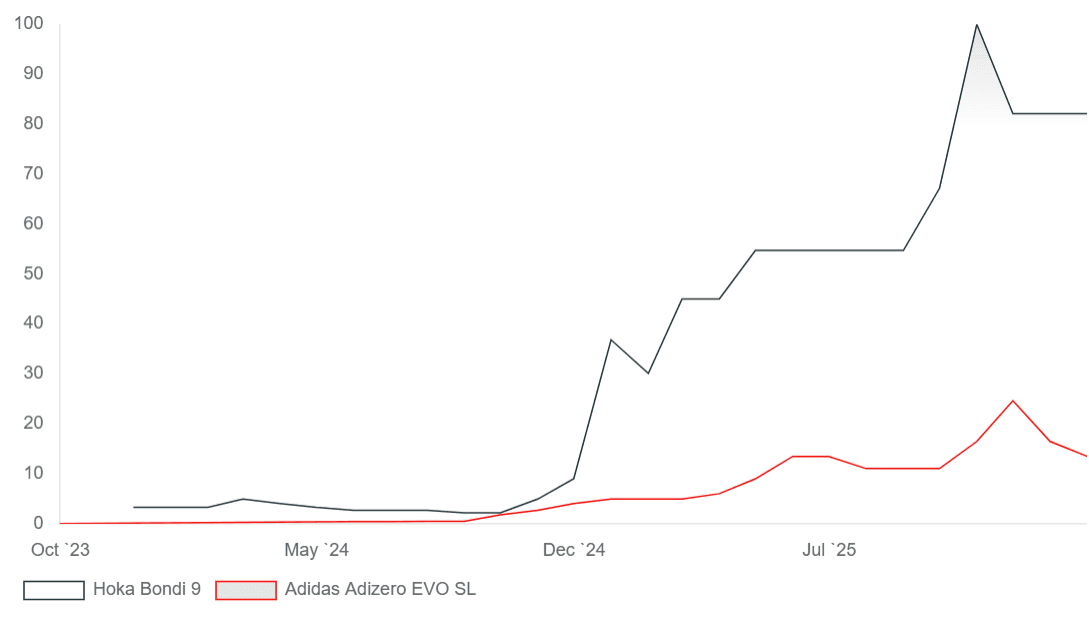
Popularity data via RunRepeat — Hoka Bondi 9 vs Adidas Adizero EVO SL, Oct 2023 to early 2026.
As seen in the graph above, the Hoka Bondi 9 is much more popular than the Adidas EVO SL. Weird, right? I think most of us would agree that the EVO SL is one of — if not the best all-rounder right now, yet the Bondi (a kinda mid shoe) is way more popular. Why? Because the EVO SL prioritizes lightweightness over comfort, while the Bondi prioritizes comfort over anything else.
The Numbers Don't Lie
Let's get into some actual data, because this isn't just some crazy idea of mine — the research backs it up. Studies show that 83% of sneaker buyers rank comfort as their number one priority when making a purchase. Functionality comes in second and aesthetics comes in at a distant third. So the vast majority of buyers aren't thinking about carbon plates, stack heights, or rocker geometry. They're thinking "does this feel good on my foot."
Even more wild, research from Simon-Kucher found that when it comes to footwear purchasing, comfort actually beats price as the top deciding factor. Price. The thing everyone assumes dominates every buying decision. Comfort edges it out. That should tell you everything about how powerful this stuff really is.
The Psychology Behind It — Why Comfort Hits Different
Here's where it gets really interesting. Comfort isn't just a preference — it's a psychological shortcut. And understanding why explains exactly how Hoka and Brooks have eaten the market alive.
Neuroscience research shows that our emotional reactions to things happen faster than our rational analysis. There's a concept called the "affect heuristic" — basically, our gut emotional response to a product sets the tone for the whole decision before we've even consciously started thinking about it. When someone slips on a Bondi in a running store and their feet sink into all that cushion, that reaction is instant and emotional. It feels good, so it is good. The brain doesn't need more information.
Compare that to the Adidas EVO SL or the Saucony Endorphin Azura. The energy return, the propulsive feel, the efficiency — none of that reveals itself in a 30-second in-store try-on. You need miles to really experience it. It's a delayed, intellectual benefit. And in the battle between "feels amazing right now" and "trust me, it'll be great after 50 miles," the immediate sensation wins almost every time.
Neuroscientist Antonio Damasio actually studied patients with damage to the emotional processing centers of the brain and found something remarkable — they struggled to make decisions even when they had access to all the relevant information. Emotion isn't just noise in the decision-making process, it's actually load-bearing. Take it away and people literally can't choose. So when Hoka gives someone an instant emotional hit of comfort, they're not just winning a sale, they're hijacking the decision-making process.
The In-Store Moment is Everything
There's also a reason athletic and casual shoe buyers overwhelmingly prefer buying in physical stores over online — it's because the on-foot experience is central to how they make their decision. They need to feel it. And this is where comfort-first shoes have a massive structural advantage.
Walk into any specialty running store and watch what happens. The staff will hand you something supportive, cushioned, and approachable, you'll take a few steps on that little strip of carpet, your feet will say "yeah, this," and that's usually the ballgame. The EVO SL might be a better all-around running shoe by basically every technical metric we care about — but it has to survive that same 30-second carpet test. And a shoe that's optimized for lightness over plushness? It's fighting an uphill battle from the jump.
The "Comfort Halo" — How One Feeling Changes Everything
Comfort doesn't just sell the shoe — it changes how people perceive the entire product. This is what marketers call a "halo effect." When a shoe feels plush and premium underfoot, people automatically assume it's also durable, well-made, and worth the price. They trust it more. They're more likely to recommend it. One good feeling bleeds into every other judgment they make about the shoe.
Brands that lean hard into comfort-focused messaging in their marketing — highlighting feel, testimonials about fit, language around cushion and support — consistently attract more buyers than brands leading with specs. Hoka's marketing almost never talks about engineering. It talks about how running feels. Brooks has built their entire brand identity around the idea that running should be joyful and comfortable. Neither of them is out here talking about their midsole foam compound by name. And they're making bank because of it.
There's also a loyalty dimension here that's easy to underestimate. People develop genuine emotional attachments to shoes that made them feel good. Someone who ran their first half marathon in a Bondi doesn't just like that shoe — they associate it with one of the best experiences of their life. That's not a customer, that's a fan. And fans keep coming back to the same shoe and brand.
So Who's Actually Winning Here?
We shoe nerds love to hate on Brooks for being boring and Hoka for being "just cushion," but maybe we're the ones missing something. These brands have figured out something fundamental about how humans actually make decisions — not how we should make decisions, but how we actually make decisions in real life, in a real store, with a shoe on our foot.
They're not failing to innovate. They're choosing to optimize for the thing that actually moves product at scale. Comfort is immediate, emotional, and universally understood. Carbon plates are delayed, technical, and require a specific kind of buyer to appreciate them. One of those things sells to everyone. The other sells to us nerds.
Maybe Brooks and Hoka are actually the brilliant ones for not chasing tech — because at the end of the day, they're the ones actually making the money.
Want to find the shoe that's right for you — not just the most comfortable one in the store? Take our quiz for personalized recommendations based on how you actually run.
Key Sources
Simon-Kucher & Partners — Comfort Is King: Consumer Footwear Priorities Report — https://www.simon-kucher.com/en/insights/footwear-purchasing-criteria
AYTM (Ask Your Target Market) — Sneakerheads and Sneaker Culture: Consumer Insights Report — https://aytm.com/post/sneaker-consumer-insights-report
Running Shoes Guru — Running Shoes Buying Habits Survey — https://www.runningshoesguru.com/content/running-shoes-buying-habits-results-from-our-survey-plus-infographic
Tandfonline — How Do Runners Select Their Shoes? An In-Store Experience Study — https://www.tandfonline.com/doi/full/10.1080/19424280.2024.2353597
The Decision Lab — The Affect Heuristic — https://thedecisionlab.com/biases/affect-heuristic
Wikipedia — Affect Heuristic — https://en.wikipedia.org/wiki/Affect_heuristic
The Decision Lab — Somatic Marker Hypothesis (Antonio Damasio) — https://thedecisionlab.com/reference-guide/psychology/somatic-marker-hypothesis
Wikipedia — Somatic Marker Hypothesis — https://en.wikipedia.org/wiki/Somatic_marker_hypothesis
Wikipedia — Descartes' Error (Antonio Damasio, 1994) — https://en.wikipedia.org/wiki/Descartes%27_Error
The Decision Lab — The Halo Effect in Consumer Perception — https://thedecisionlab.com/insights/business/the-halo-effect-in-consumer-perception-why-small-details-can-make-a-big-difference
Wikipedia — Halo Effect — https://en.wikipedia.org/wiki/Halo_effect
RunRepeat — Hoka Bondi 9 Popularity Data — https://runrepeat.com/hoka-bondi-9